
Complete guide to choosing the right football boots in the Netherlands. Compare FG, AG, and SG surfaces, find the right fit, and discover which boot suits your position.
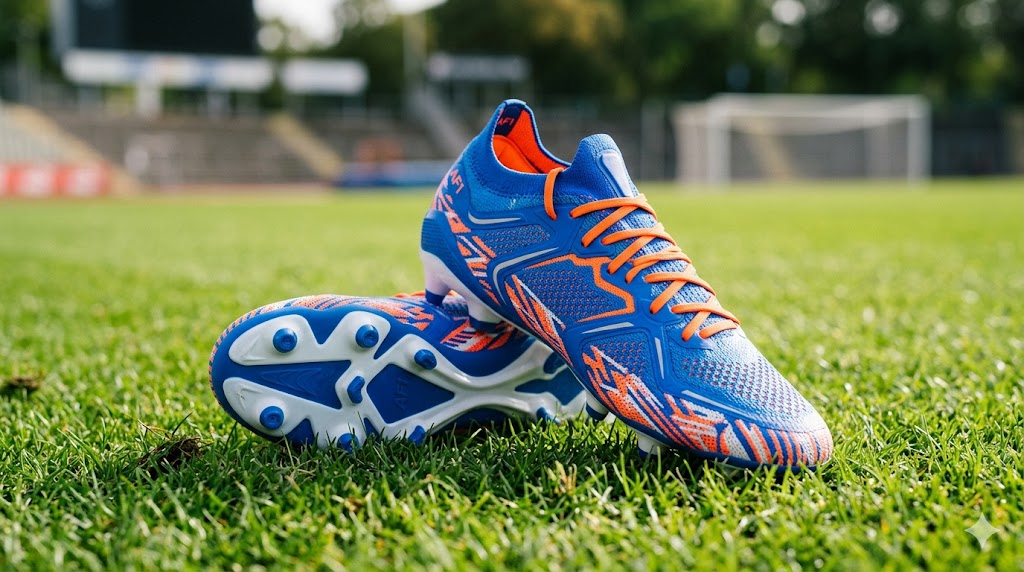
Image 1. Football boots on grass close-up showing FG studs and colorful design
What Surface Are You Playing On? Start Here
The single most important factor when choosing football boots in the Netherlands is the ground type. Get this wrong and you risk injury, poor grip, or boots that wear out far too quickly. Here is a breakdown of the main sole types and when to use them:
- FG (Firm Ground) — The most common choice for Dutch players. FG boots are designed for natural grass that is firm and dry. Most pitches at Dutch amateur clubs from August to October are in FG condition. The Veloce Control X Hunter is an FG boot built specifically for firm ground performance, with a lightweight outsole tuned for quick cuts and explosive acceleration.
- AG (Artificial Grass) — If your club plays on artificial turf (kunstgras), which is increasingly common at facilities across the Netherlands, AG boots are a must. The stud pattern is wider and more numerous, spreading pressure across the surface to reduce knee and ankle strain. Do not use FG boots regularly on AG pitches — the studs are too long and can cause injury.
- TF (Turf) — For hard, worn-down artificial surfaces like the kind found at outdoor cages or older training facilities, TF boots with rubber studs are the safest option.
- SG (Soft Ground) — In the Dutch winter, when pitches get waterlogged and soft, SG boots with longer, metal-tipped studs provide the grip you need. Many amateur players keep a second pair just for winter.
Most players at Dutch amateur clubs will get the most use from a quality FG boot. If your club recently switched to artificial turf, add an AG pair as your primary training boot.
What Key Features Should You Look For in Football Boots in 2026?
Once you know your surface type, the next step is evaluating the construction of the boot itself. Modern football boots have evolved significantly, and in 2026 the gap between professional-grade and budget boots is wider than ever in terms of materials and technology.
Here is what to pay attention to:
- Upper material — The upper is the part of the boot that touches the ball. A textured synthetic skin, like the ultra-thin synthetic upper on the Veloce Control X Hunter, enhances close ball touch while keeping the boot lightweight. Knit uppers offer a sock-like fit and are increasingly popular for attacking players who prioritise feel.
- Collar design — A high-knit collar that rises around the ankle, as seen on the Veloce X Hunter, adds stability and reduces the chance of the boot slipping during direction changes. This matters on Dutch pitches where the surface can be uneven.
- Stud configuration — Look for conical or bladed studs positioned under the forefoot for quick pivoting. The Veloce Control X Hunter features a stud layout tuned for rapid take-offs and smooth transitions at top speed — exactly what wingers and forwards need.
- Weight — Lighter boots reduce fatigue over 90 minutes. If you play multiple times a week, this adds up. Professional-grade boots typically come in under 200 grams.
- Lacing system — A precision lace system that locks the foot securely without pressure points makes a significant difference in comfort over a full match. Avoid boots where the lacing creates a hard ridge directly under the ball of your foot.
- Heel support — Look for a reinforced heel counter that cups your foot without rubbing. The redesigned high-knit collar on the Veloce X Hunter locks the ankle in place for a more secure, locked-in fit without sacrificing flexibility.
Which Boot is Right for Your Position?
Not all football boots are built the same way, and different positions benefit from different designs:
- Forwards and wingers — Prioritise lightweight, speed-focused boots with excellent close control. The Veloce Control X Hunter is purpose-built for this profile — designed for players who attack every moment with speed, precision, and control.
- Midfielders — Look for a balanced boot with good ball feel and durability. A textured upper that enhances touch is a priority.
- Defenders — Durability and ankle support matter most. Boots with a reinforced heel and a stable stud platform help when making last-ditch tackles on hard ground.
- Goalkeepers — Most goalkeepers use standard FG boots. Comfort and grip are the priority since goalkeepers make fewer explosive sprint movements than outfield players.
Size and Fit — Don’t Get This Wrong
Football boots fit differently to regular shoes. A few rules of thumb for buying boots in the Netherlands:
- Football boots are generally sized to fit snugly — there should be around 5mm of space between your longest toe and the end of the boot.
- If you have a wider foot, consider going half a size up. Boots that are too tight cause blisters and black toenails very quickly on firm ground.
- All KitNations boots come with a 14-day free returns policy, so if the fit is not perfect you can exchange them without hassle.
- Measure your foot in centimetres and compare it to the size guide before ordering online.
Why Dutch Players Choose KitNations
KitNations exists for Dutch football players who take the game seriously. Our boots are built for the conditions you actually play in — from firm grassfields in Brabant to artificial pitches in Amsterdam — and our entire range ships across the Netherlands with free delivery on orders over €290 and free returns within 14 days.
Whether you are replacing a worn-out pair before next season or upgrading to a professional-grade boot for the first time, start with the Veloce Control X Hunter — our most popular boot, trusted by Dutch players who attack every moment with speed, precision, and control.
Find your speed. Play your game.
FAQs
What is the difference between FG and AG football boots?
FG (Firm Ground) boots have conical studs designed for natural grass. AG (Artificial Ground) boots have more, shorter studs designed for synthetic turf. Using FG boots on AG surfaces can damage the boot and reduce grip.
Q: Which football boot position is best for strikers?
Forwards and wingers benefit from lightweight, speed-focused boots like the Veloce Control X Hunter, which prioritise acceleration and close ball control over stability.
Leave a Reply